Leading the charge

SEAT Mii Electric

By Bill McCarthy


CITY cars are no longer cheap and nasty, although not that many were that nasty in the first place. That has changed with the electric car revolution, so the Mii will now set you back the thick end of £20k. Pricey for such a small car.

But it boasts equipment levels usually found on premium models, somewhat mitigating the cost. These include metallic paint, sports seats, LED daytime running lights, cruise control, rear parking sensors, rain sensors and fast DC charging capabilities.

The funky Mii is the first electric vehicle from the SEAT brand, laying the groundwork for more to join the family in the future says the firm.

Longer journeys are now also less of a problem as the network of charging points grow

 But what you still get with this groundbreaking little car is the same practicality and fun as previous petrol versions, but with huge savings on fuel and carbon emissions.

The vehicle capable of a range of a claimed 161 miles on a single charge. I topped it up once during a week and that was only because I wanted to be on the safe side as the weather was shocking. Lights, wipers and demisters put a strain on the battery.

The problems of fully electric motors have always been the range, but this is becoming less of a problem as battery technology develops. Longer journeys are now also less of a problem as the network of charging points grow and the ability, like this vehicle, to get an 80 per cent charge in around an hour. Just enough time for a cuppa on a motorway service station.

Home wall box/public or work charge point will take around four hours, while plugged into an ordinary wall socket will take 13-16 hours.

The  motor, linked to a single speed transmission, provides its 61kW (83PS) of power and 212Nm of torque instantly, meaning the five-door car can reach 31mph from a standstill in only 3.9 seconds. It  simply zips away from a standing start, startling other road users with its pace.

Slightly refreshed, it still looks good, with great efforts to disguise the boxy shape with raked windscreen, neat light clusters and deep bumpers electric logo lettering at the rear and 16-inch alloy wheels.

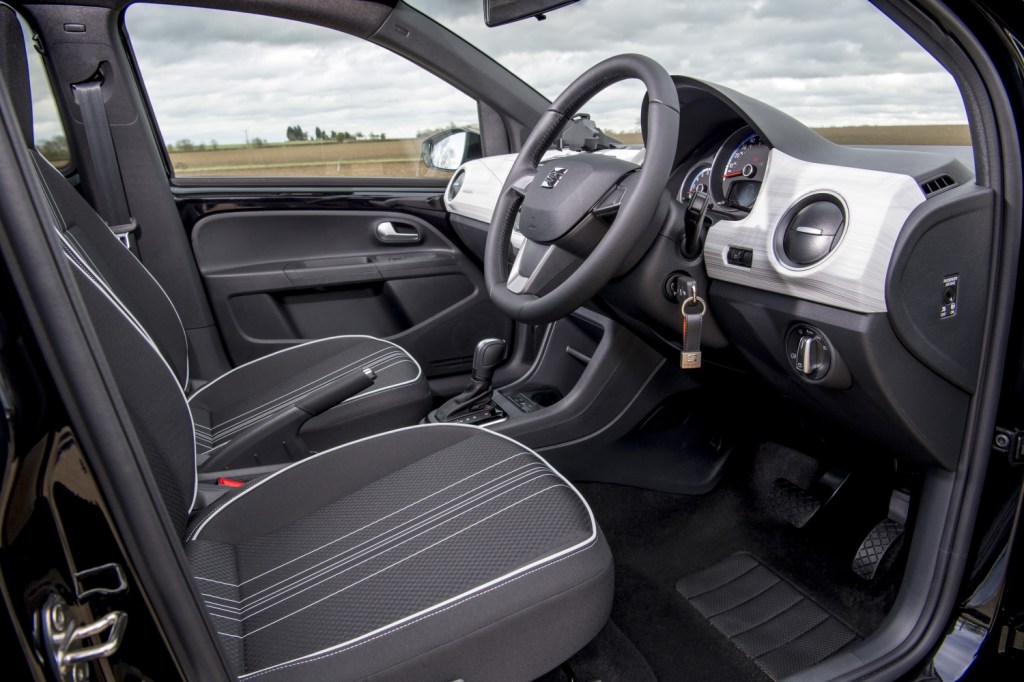
 The interior too is upgraded and, depending on your taste, looks either funky or odd, with dark interior offset by the white, patterned dashboard. Other features include, ambient lighting, sporty and heated fabric seats, black sport leather steering wheel, gear knob and handbrake.  Safety is also well catered for with features  such as Lane Assist and Traffic sign recognition as standard equipment and a good range of airbags.

The binnacle and central controls are logical, and there is no central touchscreen. Instead SEAT have introduced a cradle above the dash to hold the phone or pad to do your own thing with navigation, connectivity and infotainment via Bluetooth.

 It is also the first model to include SEAT CONNECT, which allows you to  driving data, parking position, the vehicle’s status, including doors and lights, and the ability to control air-conditioning remotely, all from their smartphone app.

  The car has been designed like a box on wheels to get maximum room inside, which it does, but not totally compromise boot space, which it doesn’t. This makes for a spacious interior with excellent headroom and surprising good legroom.

 It is practical enough despite the limited boot size, with the rear seats splitting and folding to create decent stowage space when required.

On the road, the shape means it won’t appreciate being thrown into corners, but the customised suspension does give a pleasant ride for all occupants, handling pretty well what our potholed roads throw at it. The car is virtually silent, as there is no engine or transmission noise and it is well insulated from road and wind noise.

The Mii is leading the environmentally-friendly way forward for SEAT and while it was already and excellent little car, running costs have become cheaper despite the large initial outlay.

Factfile

SEAT Mii Electric

Price: £19,800 (includes up to £3,000 HMRC electric car grant)

Mechanical: 83PS, 61kwH electric motor driving front wheels via single speed auto transmission

Max speed: 81mph

0-62mph: 12.3 seconds

Range: 161 miles

Insurance group: 12E

CO2 emissions: 00g/km

Warranty: 3yrs/60,000 miles

Lifestyle to the Max

Isuzu D-Max XTR

By Bill McCarthy


CAR or commercial, lifestyle or workhorse? Those are the questions that could be asked about Isuzu’s impossibly stylish pick-up.

With car-like comfort, surprising economy and an attractive purchase price when you take into account standard equipment, it’s no surprise that many now choose this type of vehicle to double up as the family transport.

Thanks to its 3.5t towing capacity, shift-on-the-fly 4WD system and one-tonne-plus payload, the Isuzu D-Max XTR now offers even more to Isuzu’s loyal and growing customer base.

The firm reckons the D Max range offers ‘go anywhere, do anything’ qualities and it comes in many guises from single or double cab, straight flat bed or with an option to fully enclose the payload area.

But the double cab is surely the most appealing of this dual purpose vehicle with its five seat arrangement and comfort to match most family saloons. It’s also now challenging the flashier SUVs in the coolness at the school gates appeal. A vehicle that begs to be gawped at.

 Clearly its workhorse credentials are self evident. But addressing practical problems such as boot capacity for family items such as shopping and household goods, while still transporting the odd few bags of concrete has been addressed in an ingenious manner on this version, with a series of sliding, lockable metal boxes under the payload floor.

With the 125,000 mile/five-year warranty it is quite a tempting package. It doesn’t half look the part as well

One runs the length of the flatbed, while the other two have various compartments, ideal for storing small tools or even items of shopping. You can still then add a couple of bags of concrete above on the flatbed, which can then be concealed with the optional rolling cover or left open to the elements, depending on what you’re carrying.

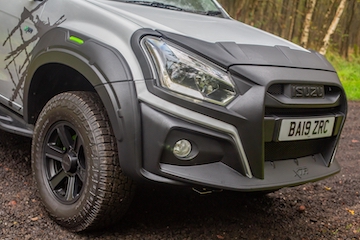
It looks the part all right on huge alloys with 17-inch six-spoke alloys in satin black shod with specialist Pirelli Scorpion All-Terrain Plus tyres, designed for off-road, but more than capable of delivering a reasonably comfortable ride on-road, imposing grille and foglights and side running boards to help you haul yourself into the cab.

Green colour coding has been incorporated into the front coil springs and dampers, front brake caliper, rear anti-roll bar and rear dampers, giving the kind of presence more associated with premium vehicles.

The interior is pretty upmarket for the type of vehicle, with powered, leather seats with contrasting green stitching. The  XTR logo is embroidered on the backrest of each front seat and is repeated on the rear centre headrest.

The double cab means five are carried in reasonable comfort, although rear carrying capacity is obviously reduced. In pure workhorse terms, a single cab could offer more carrying capability.

Creature comforts including air con, electric windows, central information screen controlling navigation, connectivity and sound and with the option of Apple and Android phone connectivity. Also included is a raft of safety kit and, importantly for such a long vehicle, rear camera.

The vehicle is powered by a 1.9 litre diesel engine, with auto transmission and on-the-fly capability of selecting four wheel drive with a dial on the central console.

 The firm says it is built to endure the harshest conditions, with a 250mm ground clearance and no compromise on vehicle handling and stability.

The brakes too have been uprated with Kevlar ceramic front brake pads working in combination with the discs to give a much improved stopping power.

The modified Pedders suspension means it can cope with extreme terrains, but does not make you feel seasick when on flat roads. Although you cannot escape some wallow on corners, it is surprisingly agile for such a big beast. 

On the road, the diesel has plenty of power if not a great deal of refinement. The 162bhp is more than capable of delivering the grunt needed for serious off-road work, while at the same time offering enough pace on road to more than cope with both general and motorway driving. The initial diesel clatter does eventually die down, while the auto shift was nowhere near as hesitant as some I have driven. Economy was surprisingly good with a claimed 36-odd mpg seeming pretty much near the mark.

It’s not cheap at a price approaching £44k inclusive of VAT, but there are clear fiscal benefits with this type of vehicle with a fixed tax rate. In addition there is the 125,000 mile/five-year warranty and five-year roadside assistance to offer quite a tempting package.

It doesn’t half look the part as well.

Factfile

D-Max XTR Nav+ Double Cab Auto

Price: £36,694+VAT

Mechanical: 162bhp, 1,989cc, four-cylinder diesel engine driving four wheels via auto gearbox

Max speed: 112mph

0-62mph: 12.7 seconds

Combined mpg: 36.2

Insurance group: 42

CO2 emissions: 205g/km

Warranty: 5yrs/125,000 miles