Supercars with power and panache

The stylish and powerful McLaren GT
The more powerful, yet equally stylish McLaren 720S

McLaren GT and 720S

By Bill McCarthy

When is a supercar not a supercar? Well according to McLaren, it’s the GT, classed as Grand Tourer, but without doubt delivering supercar performance. Its stablemate, the 720S, has no such nuances and is classed as an out and out supercar.

There’s no doubt both deliver supercar prices, with the GT starting at £163k and the 720S from £215k.

Both offer stunning performance on the track or, when permissible, on the open road.

Both look stunning with 720S coupe and 720S Spider cabriolet delivering a brutal 720PS from its four litre V8 engine, while the GT delivers a less muscular 620PS, but both are capable of reaching 200 mph.

Both are light with monoframe bodies surrounded by carbon fibre chassis and aluminium panels, which also allows for good interior space and the lowest kerb weights. At 1,530kg (DIN), the McLaren GT is more than 130kg lighter than its closest core competitor

There’s also practicality in the shape of the GT, with ample room under the full length, glazed, powered tailgate for a set of golf clubs and, because it is mid-engined, space in the front storage area. The 720S is tighter with baggage space behind the seats and 150 litres of space under the front pane.

The low height of the engine and positioning of the exhaust system has allowed the volume, shape and usability of the luggage bay to be optimised. 

A golf bag or two pairs of 185cm skis and boots, as well as luggage, can be carried with ease, while a further 150 litres of storage at the front means the GT can accommodate a total of 570 litres.

And unlike some supercars where you need to be a contortionist to get in and out, the signature gull-wing doors offer easy access and egress, although the GT offers the easier access of the two.

They look the part, sleek and elegant with longer overhangs, muscular curves, with large air scoops, showstopping alloy wheels and aerodynamically turned to slice through the air with minimum resistance.

A key feature on the 720S is the absence of radiator intakes on the side of the car, which has been replaced unique ‘double-skin’ aerodynamic form of the dihedral doors, which channel air to the high-temperature radiators that cool the mid-mounted engine. 

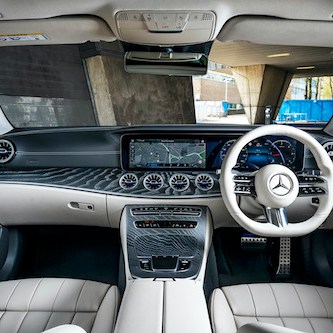
As you would expect with both cars, the cabin is sports focussed, but offers some luxurious leather offset by aluminium switchgear, and high-end sound system although not on the same level as a similarly priced Bentley Continental GT.

The GT has a more sophisticated feel, with the 720S more stripped back to unleash the extra power.

On the road, both are remarkably responsive and the harder you push, the better the drive. Both were taken on a simulated Alpine route, followed, a straight mile power run and laps on a two mile oval banked track.

Both are mated to a seven-speed auto transmission with the option of using steering wheel paddles. 

The immense power and torque of both were evident at all times as was the superb handling on the twisting, sometimes icy mountain track.

With the aid of the new generation of McLaren’s Proactive Chassis Control combined with power-assisted, electro-hydraulic steering they deliver a thrilling experience as they cling limpet-like to the road on the tightest of hairpins. 

They respond with an almost balletic poise as the steering keeps the car where you are pointing it.

In addition, the Proactive Chassis Control suspension of the 720S, uses inputs from sensors to ‘read’ the road ahead, interpreting what is likely to happen next and reacting predictively in just two milliseconds.

Switch to the straight mile run for blistering acceleration, both the GT and 720 race to 60mph in 2.8 seconds, and 3.2 seconds respectively. Stand on the brakes as they end of the track approaches at 150mph and the car comes to a standstill in just over four seconds.

For those looking for an even more raw, full-fat driving experience, choose from Comfort, Sport, or Track modes for an even more jaw-clenching experience.

Just as impressive is the GT which can hit 60mph in just 3.1 seconds and on to 125mph in just nine seconds, again with instant braking.

And just in case anyone hadn’t noticed you, a bespoke exhaust system can deliver a spitting crackling roar under acceleration, or a more discrete sound under more normal circumstances.

Stunning performance, but both are capable of being driven in a more sedate environment with the braking and steering at lower speeds optimised for everyday ease of use as ride height and ground clearances engineered for urban usability

Creature comforts are catered for with the GT offering Standard, Pioneer and Luxe interior specifications with high-quality materials throughout and advanced technologies including ambient lighting, new McLaren Infotainment System II and optional electrochromic panoramic glazed roof.

The 720S comes as Standard, Performance and Luxury trim.

Suffice to say economy and CO2 emissions are nothing to write home about, but when you spend on a car, it’s not a major issue, is it? 

There’s no doubt they are superb cars and brilliant to drive. Supercars in the true sense of the word.

Rugged but sophisticated Outback rules

Subaru Outback

By Bill McCarthy

LONG seen as virtually indestructible, the Outback is not a car that you see a lot of in the UK, so it provided a lot of interest while parked up. Firstly the relative novelty value, secondly the number plate Su13aru and third, it looks pretty good.

It has been around for a long time, 25 years in fact, and has become a staple for those who love full fat off-roaders or those in semi-rural locations, who may need that kind of capability in remote country lanes when the weather closes in.

Subaru says the latest version is simply, the toughest, most rugged, most capable SUV ever produced. It certainly looks the part.

So, rugged and to be honest a little bit agricultural in the past, the latest model is something else altogether. It is the most refined model yet with sharp exterior design and an upmarket interior, dominated by a tablet-style touchscreen, very much in the Volvo mould.

There are three versions, Limited, Field and the range-topping Touring. All are packed with equipment with this mid-range Field model offering goodies such as the latest version of the Subaru Eyesight safety technology, which features facial recognition that detects tiredness in the driver. It can also remember the driving preferences of five users.

Sitting on the Japanese car maker’s new global platform it looks like an estate car on steroids, with it’s high ground clearance and 18-inch alloy wheels, it has a rugged yet sophisticated appearance.

It has coupe-like styling featuring smart lights clusters with LED daytime lights and privacy glass, offset by large wheel arch protectors and protection to sills and bumper and featuring integrated roof bars. It looks more European than ever, which is clearly what Subaru is hoping for.

It is a big car, easily seating five occupants in comfort, and with good head and legroom and good all round visibility.

It is powered by a 2.5 litre Boxer engine mated with the now familiar Lineartronic transmission. Economy is not what this is about, although at around 33mpg for a 2.5 litre engine pulling such a hunk of metal is not too shoddy. That power also gives it a two-tonne towing capacity.

Acceleration is brisk for this kind of vehicle and it hits 60mph in just over 10 seconds, and although I am not a huge fan this type of transmission, the shifter paddles behind the steering wheel give the chance for a more sporty drive.

Though much more sophisticated, it has a dual role as a workhorse with features such as fatigue-reducing water repellent leather-style seats on this model and hard-wearing and washable boot space. But there are plenty of creature comforts including eight-way powered and heated front seats with lumbar support, climate control, heated and powered door mirrors, and aluminium pedals.

In practical terms,  stowage space is huge with 60/40 split rear seat operated by a release lever and accessed via a powered, hands-free tailgate.

As before, the car features Permanent Symmetrical All-Wheel Drive and X-MODE. Using the touchscreen, the driver can switch modes to negotiate snow, dirt, or gravel, or a mud mode for soft conditions where lesser vehicles get stuck. When X-MODE is activated, hill descent control automatically maintains a constant speed when travelling downhill.

Inside the car, the cabin offers a  commanding driving position that ensures optimum visibility. It has a high-end feeling and is much improved on what went before. The touchscreen is very much the brains of the car and controls major functions like navigation, connectivity for smartphones and infotainment.

Today’s vehicles are so safe, but the Outback is one of the safest with the EyeSight Version 4.0 which includes adaptive cruise control, lane assist and centring assistance, plus lane sway and departure warning.

Factfile

Subaru Outback Field AWD

Price: £37,995

Mechanical: 169PS, 2498cc, 4-cylinder, petrol engine driving all wheels via Lineartronic CVT transmission

Max Speed: 120mph

0-62mph: 10.2 seconds

Combined MPG: 32.8

Insurance Group: 17

C02 emissions: 193g/km

Bik rating: 37%

Warranty: 3yrs/60,000 miles

Welcome to this site