Greek tourism prepares for future

The Aldemar Olympian Village in the West Peloponnese in Greece

Aldemar Resorts 2020, the year that has yet to begin for the tourism industry in Greece 

Greek Minister of Tourism, Harry Theoharis has been considering ways of salvaging the sector with his EU counterparts in this era of Covid-19. As the threat of the pandemic recedes, considerations for measures that will encompass health and safety for travellers are as important as lockdown was to combat the initial threat that Greece faced two months ago.

Aldemar Resorts (www.aldemar-resorts.gr) Vice-President Alexandros Angelopoulos and his management team are following the developments closely as they consider Aldemar Resorts’ own strategy.

Looking Forward

Aldemar Resorts stayed in touch on a regular basis with their UK tour operator partners, sharing information and ideas on the way forward. 

Alexandros Angelopoulos commented “Greece is universally recognized as a country that has tackled the Covid 19 crisis in an efficient and balanced way.  Not only have we contained the virus from spreading faster than anyone else, but also applied measures to avoid further contagion, such that we are recognized as one of the safest destination in Europe. This, in itself, is the basis of our strategy to getting back to being the safe and attractive destination that we have a reputation for being.  It will take time and we expect people to be tested before they board planes and from our part will be applying very strict health and safety protocols for staff and guests.”

Considerations

Aldemar Resorts are considering four key areas:

Hygiene; we are involving expert partners in the field to achieve ‘hospital standard’. 

Staff; all personnel will be tested before they can rejoin the hotel’s workforce. 

Heating and air-conditioning; as a precaution the engineering and maintenance departments have been working on disinfecting all areas of the resort hotels and introduced new protocols for heating and air-conditioning of all areas hygienically.  

Food and beverage; here the big buffet with multiple choices despite its high standards and quality will be replaced by a la carte service. 

“In Crete and Western Greece where our six hotels are located, the incidents of infection are none since the beginning of April” adds Alexandros Angelopoulos.

“Although it is still too early to say whether we can expect an extension of the season given the late start, following on from the directives of the state and our tour operator partners, we will consider extending our operation past the month of October.  Of course, this is not only up to us, but relies on global efforts to contain the virus and develop accurate measures for the protection of all people” concludes Alexandros Angelopoulos

Aldemar Resorts is one of the leading hotel chains in Greece with a total capacity of 3,738 beds and 1,200 employees.  

The group has six deluxe hotels, four in Crete and two in the Western Greece, as well as two world class Thalasso Spa Centres, one in Crete at the Royal Mare Hotel and the other on the mainland in Western Greece at the Royal Olympian. 

The Aldemar Group has 33 years in the tourism market and is recognised as being one of the most dynamic businesses of the Greek hospitality industry. Its success is due to continuously investing in innovative products and ideas and by demonstrating a high level of responsibility toward people, society and the natural environment.  With this attitude it hopes to respond positively to the challenge of restarting the sector, a major component of the Greek Economy. In Greece, tourism accounts for 20% of GDP and provides one in five jobs. In 2019, Greece attracted a record 33 million arrivals, more than three times its total population, and double the number it attracted a decade ago.

For further information visit www.aldemar-resorts.gr
http://www.visitgreece.gr

A worthy flagship

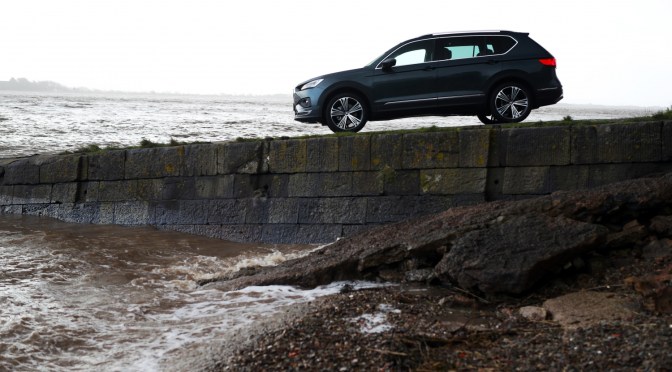
SEAT Tarraco

By Bill McCarthy


SEAT has long been known as the sporty looking arm of the VW family, featuring sharp, angular styling with natty trim flourishes and smartly-designed light clusters and alloy wheels.

So the trick for the Spanish-based firm was to adapt to the rising demand for crossover/SUVs.

With the Arona, then the Ateca and then the flagship Tarraco it has achieved this with practicality and some élan.

The Tarraco, says  the firm, is designed for drivers who need the usefulness of a seven-seater and the practicality of a higher driving position but are conscious of a vehicle’s aesthetics and appreciate the balance between self-confidence, elegance and sportiness. 

The range topper driven here is packed with bells, whistles and gizmos found on motors costing considerably more

Market speak I know, but you can see what they are getting at with sculptured exterior design, high end  interior and impressive selection of power units, this case a lively two litre unit. (There are three petrol and two diesel variants on offer)

The Tarraco – named after the old name for the Spanish port of Tarragona – is a big seven seat motor a flagship in all respects with high quality fixtures and fittings.

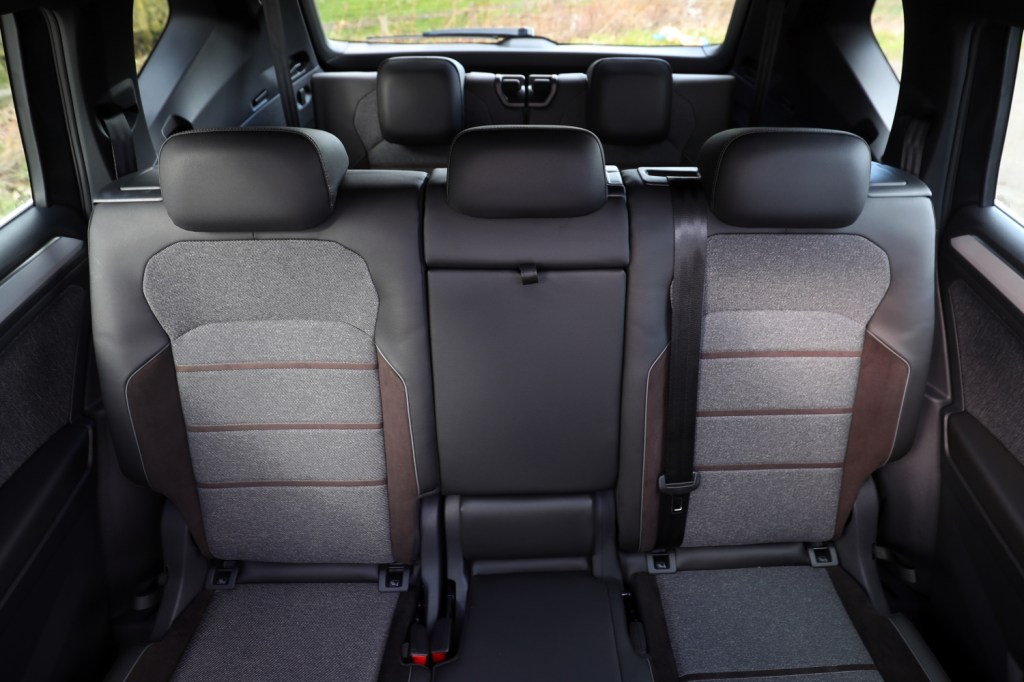
 Very importantly it has a huge cargo area, with from 230 litres with seats in situ, to 700 litres with the rearmost folded  and 1,775 with all the seats folded, which makes it hugely practical. There are also plenty of other pockets and cubby holes throughout.

A big car, but not cheap and cheeful as they start at just over £28k with this model nearly £34k. Having said that the range topper driven here is packed with bells, whistles and gizmos found on motors costing considerably more.

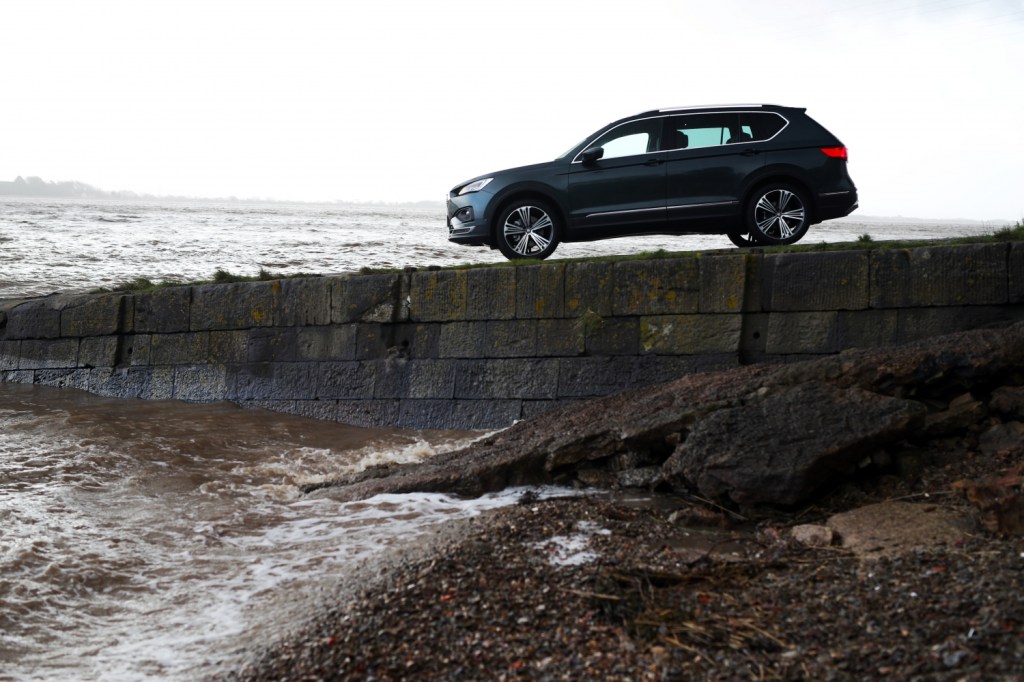
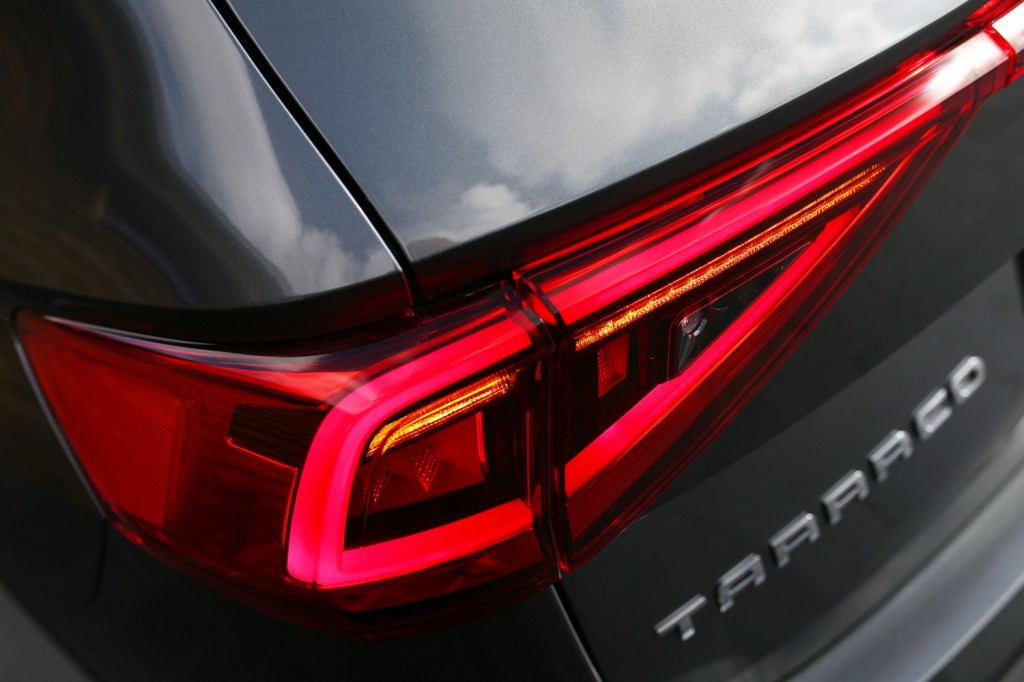
It does look good with sporty grille design flanked by angular LED technology headlights, which, says SEAT, retains the company’s triangular signature. Add to this ultra-smart alloy wheels, integrated roof bars and raked bonnet and it is perhaps the sportiest looking SUV to be found.

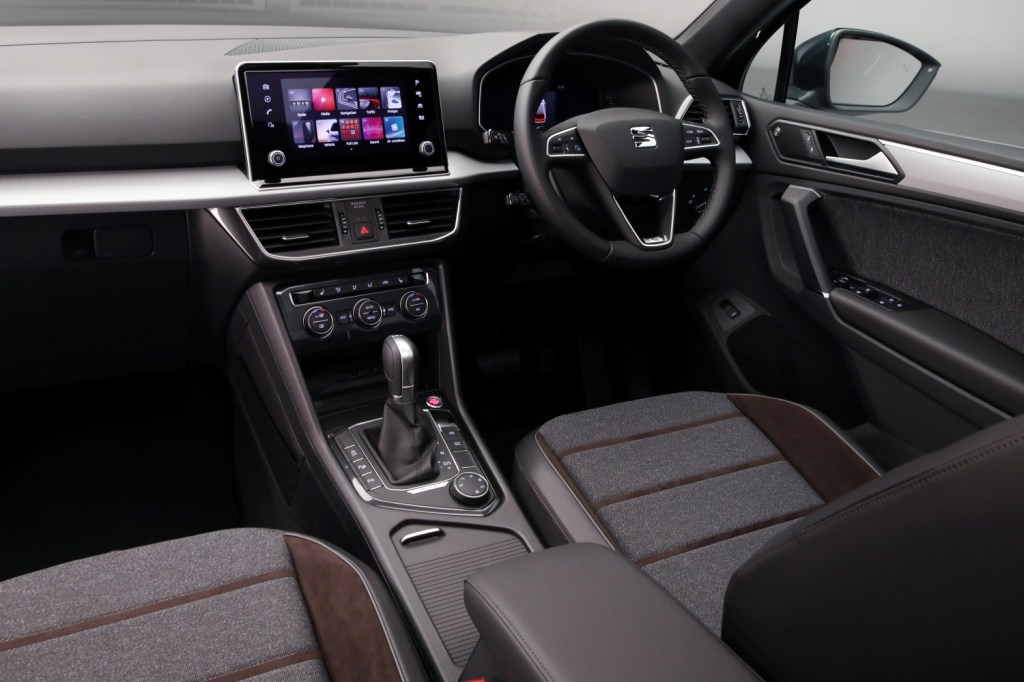
The interior more than matches the outside with elegance and practicality and a mixture of soft and hard touch plastic trim.

Like many, the traditional dash and dials is more of a 12.8 inch wide ‘cockpit’ , with a  touch screen controlling major functions.

Five are seated comfortably, with adjustable, Alcantara trimmed powered seats at the front on this model.

There is ample head and legroom, but less so for the third row which are cramped.

The connectivity and infotainment system are controlled via a pretty much eye-level ‘floating’ screen. This is the brains controlling navigation system, music and Android Auto and Apple CarPlay smartphone and wireless connectivity where fitted.

On the road the 150PS diesel is a refined and impressive performer, meaning the sporty looks are complemented by the sporty performance. Mated to a slick six speed manual box. It hits 60mph in just under seconds. For a more engaging driver, you can select  Normal, Eco, Sport and Individual setting to alter driving dynamics.

There is little evidence of diesel clatter and the cabin is a quite place to be with little wind or road noise. Handling is surprisingly good, dynamic even, for such a big car and feels agile, with sharp, weighted steering and the suspension soaking up the worst our roads have to offer.

Safety kit is comprehensive with stability control and complement of airbags. front assist with bicycle detection, lane assist, tiredness recognition and emergency call as standard throughout the range, while this range topper includes park assist, electric tailgate with virtual pedal and top view camera system.

It’s a worthy flagship with smart looks, huge practicality and, considering the equipment a decent price.

Factfile

SEAT Tarraco XCELLENCE Lux 2.0 TDI 150PS

Price: £33,875

Mechanical: 150ps, 1,968cc, 4cyl diesel engine driving front wheels via 6-speed manual gearbox

Max speed: 126mph

0-62mph: 9.8 seconds

Combined mpg: 47

Insurance group: 25E

CO2 emissions: 129g/km

Warranty: 3yrs/60,000 miles

Welcome to this site