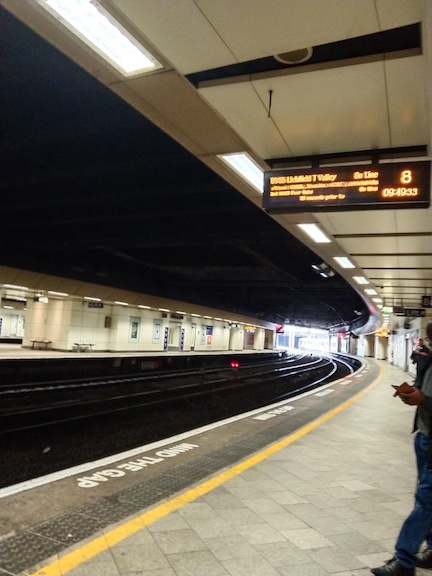
Category Archives: Travel

All aboard for a not so fantastic journey

First holiday since lockdown has a sting in the tail

When it all went pear shaped in the comedy Trains, Planes and Automobiles starring John Candy as Del and Steve Martin as Neil, Del said when they were at their lowest ebb: “You’re in a pretty lousy mood, huh?” Neil: “To say the least.” Del: “You ever travel by bus before? Your mood’s probably not going to improve much…”

We knew what he meant on a journey, if not quite from hell, but close to it.

Our first venture abroad since coronavirus struck turned out to be an excellent affair in Cyprus, but it was topped and tailed with something not quite so thrilling and a cautionary tale when preparing to fly from distant airports.

Our flight, from Gatwick meant a lengthy trip from the Midlands and paying for just over a week’s parking at a nearby site. At a cost of £74.

Trouble was, we never made it. Our car broke down on Good Friday and we were due to travel on Easter Monday. No way of getting repaired during the bank holiday.

Fortunately, our son was able to drive us to the airport, but as our return was landing at 2.30 in the morning, we felt we could not ask anyone to make that journey and then drive back.

So we kissed goodbye to the £74 (we should have insured it) and made alternative arrangements to get back.

This entailed booking a coach from Gatwick at 3.50 in the morning. What an adventure when we get back, we thought. A case of panic leading to temporary insanity.

Our journey back after eight glorious days eventually took us 16 hours.

Taxi, plane, coaches, two of them, a train and two buses.

It went like clockwork to start with, except we got there a bit too early by taxi and the airport took their time.

A four hour and 40 minute flight followed in the most uncomfortable airline seats I have ever used, but we arrived on time at around 2am.

As you would expect even at that time of the morning, around four flights came in at the same time, so passport control, as you would now expect did not have the biometric machines   working and the queues stretched an stretched . . . and stretched.

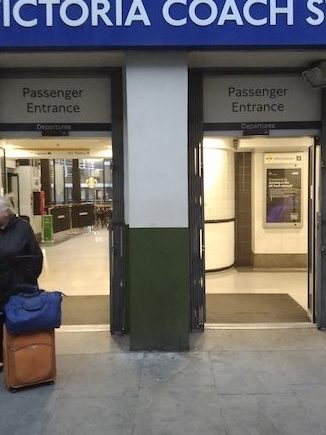
Feeling weary now, we eventually got through and boarded our first coach to London Victoria, on time mercifully and after various stop offs arrived at London’s Victoria coach station. From there we changed coaches for our three and a half hour drive to Birmingham, via Coventry.

From there, we thought we would walk to New Street Station. Mistake, dragging a 50lb suitcase, a smaller suitcase, two heavy handbags up the hill was takings its toll. We arrived at New Street Stations, back entrance and were faced with dragging the bags up 50 steps.

New Street Station is spectacular to look at inside and out but sadly I was baffled and really upset by the sight of the huge mountain of concrete stairs limiting access to the main entrance of the station for folks of all ages that are not able bodied. For people who have to hump heavy luggage. How on earth did the designers also expect parents with babies and buggies (plus other small children, not to mention many elders and folks with health problems) to climb the Everest like stairs? 

Gasping and sweating at the top, two young blokes asked, if we needed a hand. Cheers pal, but we’ve done the hard work.

Onwards. Our train was next, followed b the first of two buses.

Then it was the final walk to the house, just like Dell and Neil in the film the final scenes from the film.

We felt like we had been on a 14 hour workout, using suitcases for weights.

Tired through lack of sleep, but luckily with enough adrenaline to help us complete an epic journey.

The moral to the story is: make sure your car is ready for the journey; make contingency plans for when something might go wrong; try and insure anything like long term parking and finally, think. Do you really need that much luggage?

Range anxiety puts the brakes on holiday break

 A thought-provoking journey in an electric car

They call it range anxiety, but at times it can feel like range despair. Range anxiety is the fear that there will not be enough power in the battery of our electric vehicle to get to your destination. Something that happened on a trip to the Lake District.

Range anxiety has been around since modern electric cars first hit the road in the shape of the Nissan Leaf.

I drove one of those around 11 years ago, to a football match dur- ing the cold and rain and left again in the dark.

It was not fully topped up, but the range was showing 64 miles, to cover a round trip of 24, but with the lights, wipers and heater drawing the power, just one mile was showing on the range when we got home. That’s range anxiety.

More than 10 years on battery life has improved immeasurably, with some models boasting a range of around 350 miles, enough for most journeys.

And the costs benefits are obvi- ous, particularly with spiralling fuel charges.

They are still not cheap to buy, even with the Government EV grant. But if you do decide to go electric, everything is cheaper with zero road tax and the lowest Benefit in Kind ratings if you are a compa- ny car driver. There are of course costs to your electric bill but these are outweighed by savings on petrol and diesel.

But there’s still range anxiety.

The picturesque fells in the western Lake District

This is despite the increase in the number of charging points at service stations and their fast-charging facilities which will deliver an 80 per cent charge in around 20 minutes.

Which is great if you are not in the queue to use one which, as it turned out, was quite often in a journey from hell to the Lake Dis- trict.

It was a bit of a dilemma, should we take a relatively untried model with a claimed range of 195 miles on a proposed round trip of 450 miles? What better way to test it I thought. Well it was a test all right,

Some careful planning was needed. Yes, there were several charging points at motorway services right up to Lakeland itself.

So a quick top up to 80 per cent range on one of the latest fast chargers at an M6 service station around half way should do the trick, before completing the 190-odd mile journey to our destination.

We were also aware that once inside Britain’s biggest and arguably most beautiful national park,

Finding a charging point can sometimes prove to be a headache and charging points would be far less frequent. So a few were pinpointed, just in case.

Well you know what they say about the best-laid plans.

The minute we hit the motorway the heavens opened. At this point the range was showing 140 miles, but once the wipers, lights and demister came on, and travelling at above 60mph, the power meter headed south in a big way and guess what? Range anxiety set in.

Two M6 services stop offs were needed. The 100kW fast chargers are easy to use. Just plug it in, show your credit/debit card and within 20 to 30 minutes you will have at least an 80 per cent charge.

The second stop was nearer our destination as the range was again plunging alarmingly, but there were problems with charging. One station was out of action and the other would not charge until the car next to me had finished.

All this added to journey time and a growing sense of frustration and trepidation.

By the time we got off the motorway, it was getting dark and still raining heavily with about 60 miles to our destination and the predicted range dropping relentlessly.

Ninety buttock-clenching minutes later we arrived, with a range of just under 40 miles showing. So what next?

The Lake District EV infrastructure is patchy to say the least. So we had to spend our second, and only full day, planning how to charge up. We found one place at a hotel that was free, but out of action. Again range anxiety.

However, it was a beautiful day and where we were staying had spectacular views across the western lakes and fells. So we pretty much stayed put and approached a friendly campsite owner who agreed to let us use our three-pin trickle charger overnight.

That can give a full charge, but takes up to 15 hours from flat. However, ready to journey back the next morning, we had a full charge.

The return journey pretty much mirrored the first. Driving rain, multiple charging stops and problems finding unoccupied charging points and, yes, arriving with about 40 miles range left. One thing this trip has shown is that just like petrol or diesel motors, fuel figures take a battering when cold, electrical components and speed come into play.

With combustion engines, however, filling stations – even in the Lake District – are plentiful. Not so with charging points and the same applies to most rural areas. Electric cars are seeing rapidly growing sales and are widely perceived as the future of emissions-free motoring, with combustion engines are due to be phased out by 2030 and hybrids by 2035.

Hopefully, by then, range anxiety and infrastructure problems will be a distant memory.

Even with the current energy crisis, EVs remain cheaper to run than combustion engines. I have driven many electric cars and no matter what the predicted range is, you cannot stop yourself keeping an eye on the range.

It is the first time I have driven one this far, in such awful conditions, and it will be a rare occurrence for most. But for those using it for work and travelling the country, it needs careful consideration before taking the plunge.