Category Archives: Motoring news

Staggering £70,000 cost of drink-drive conviction


Drivers, who may have taken a chance with having an extra one for the road over the festive season, have been warned of the severe financial consequences of a drink-drive conviction.

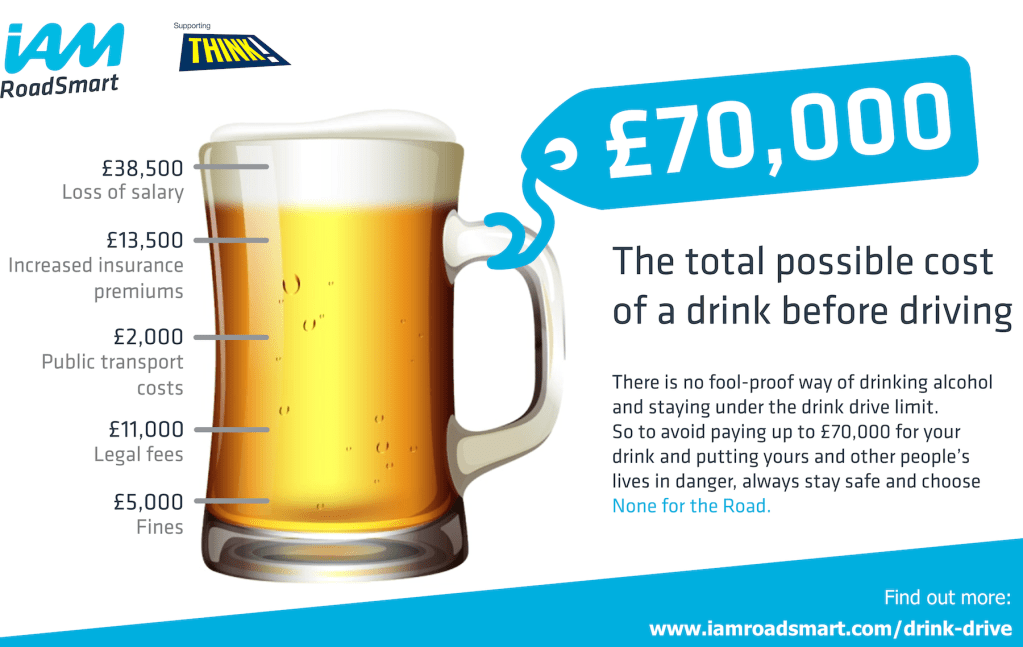
The UK’s largest independent road safety charity, IAM RoadSmart, has calculated that the personal financial cost of drink driving could be as high as £70,000 or more when taking into account fines, legal fees, higher car insurance premiums, alternative transport costs and potential loss of earnings following conviction.

IAM RoadSmart’s research team found that costs following a drink drive conviction now include: fines of £5,000, although since these are now unlimited this could be much more; legal fees of £11,000 which is the average following conviction after a not-guilty plea; increased insurance premiums of £13,500 over five years after a driving disqualification; £2,000 for taxi and public transport costs for alternative transport during a ban; and £38,500 loss of earnings for 15 months following a conviction, based on an average UK salary.

Neil Greig, IAM RoadSmart Director of Policy & Research, said: “In the run up to Christmas this year, many people’s drinking habits will have changed as a result of the coronavirus. So, whether you’re raising a glass for the festive season at home or, where you’re able, in a restaurant or pub, it’s important to remember that an extra drink comes with a huge hidden cost if it pushes you over the limit.”

Roads Minister, Baroness Vere, said: “Drink driving kills, so during the festive season don’t be tempted to have a drink before getting behind the wheel – it’s irresponsible and incredibly dangerous. We are working tirelessly, through schemes like our award winning THINK! campaign, to tackle attitudes and behaviours that could lead to people drink driving, and we continue to invest in policing and enforcement on our roads.”

Neil continued: “Drink driving wrecks lives and is totally unacceptable in any circumstance. However, some people still think they are safe to drive when they’ve had just a couple of drinks or are using home measures, which can quickly push them over the limit.

“The £70,000 impact of being convicted of drink driving is very sobering. This should be more than enough, let alone the thought of causing any other suffering for yourself, your family or the other people you put at risk on the road, to stop those drivers who are tempted to have an extra drink and get behind the wheel.

“Our advice is therefore quite simply to always stick with ‘None for the Road’”.

For further information visit www.iamroadsmart.com/drink-drive.
No switch for electric car owners

Less than 1% of drivers want a return to petrol or diesel


Drivers have taken to electric vehicles with a passion, with virtually none looking to switch back to internal combustion engines.

A new poll of Zap-Map’s community of electric vehicle (EV) drivers has revealed  more than 90 per cent of drivers will not be replacing their current EV with a petrol and diesel vehicle.

A spokesman for the RAC said the figures show the momentum that is behind getting drivers into electric vehicles, something that is likely to build as we move closer to the end of the sale of new petrol and diesel cars by 2030.

The results are strong evidence of the fundamental shift in consumer attitudes in favour of environmentally friendly cars. In the poll, which was carried out in November 2020 with over 2,000 respondents, 91 per cent said “no thanks” to replacing their EVs with a petrol or diesel vehicle; and in stark contrast less than one per cent were hankering for a return to fossil fuels. nine per cent said they were not sure.


The majority of respondents were first-time EV drivers, with 73 per cent stating their current vehicle was their first EV, and 52 per cent making the purchase within the last year. Driver satisfaction was notably higher for both battery electric and plug-in hybrid vehicles, with EV drivers reporting a satisfaction score of 91 out of 100 (BEV 92, PHEV 84), compared with only 72 for petrol or diesel vehicle ownership.

The data overwhelmingly shows the positive impact of the EV experience on drivers who may have become accustomed to loud, inefficient, and dirty fossil fuel vehicles.

EV models which received the highest satisfaction scores included: the Volkswagen ID.3, Kia Niro Plug-in Hybrid, and BMW 3 Series saloon (all 100); Tesla Model 3 (96); Kia e-Niro (96); and the Hyundai KONA electric (94). Nearly all the models, including popular ones such as the Renault Zoe (92) and Nissan Leaf (90), also achieved high levels of driver commitment.

The survey results come at a time of record-breaking sales for the electric vehicle industry. Latest industry figures show that for the year-to-date 9.7 per cent of all new car sales had a plug, compared to 3.2 per cent in 2019, and 1.1 per cent in 2015.

Melanie Shufflebotham, Co-Founder of Zap-Map, commented: “Our latest poll shows the strong and enduring impact of switching to a clean car. The evidence in favour of electric vehicles grows more compelling with each one of our surveys, even in a year as disruptive as 2020. 

“The challenge for the automotive industry is to take advantage of the opportunities that EVs present, not only in terms of the rapidly expanding range, but also ensuring that sales staff are knowledgeable enough to present the benefits to their customers. 

RAC spokesperson Rod Dennis said: “While the challenge is often convincing owners of petrol and diesel vehicles to switch to an electric vehicle in the first place, this data shows that once people have done so they seldom look back – which is also positive news for manufacturers that are investing heavily in electric vehicles and cleaner technology. 

“While would-be electric car drivers might worry about range anxiety, they should also be aware that the number public charge points is increasing rapidly and infrastructure continues to improve. They should also remember that the vast majority of their journeys are unlikely to be over several hundred miles meaning that for day-to-day travel, operating an electric vehicle is a clean and cost-effective option.

“These figures show the momentum that is behind getting drivers into electric vehicles, something that is likely to build as we move closer to the end of the sale of new petrol and diesel cars by 2030. We are doing our bit in giving drivers confidence they can make the switch, with 80 of our patrol vans now fitted with mobile emergency charging units, and half our fleet fitted with All-Wheels-Up recovery systems, removing the need for drivers to wait for a flatbed if they need a tow.”