All posts by Macfivenews

Motoring and travel journalist, opinionated gob on a stick

Suzuki story started with a loom

Firm celebrates 100 years of innovation

Celebrating a centenary, a very special occasion indeed, in the middle of a pandemic is a challenge and something that could go spectacularly wrong.

It went wrong for Suzuki in the sense that it should have been 2020, but everything else they put on during celebrations in the Welsh capital of Cardiff proved spot on.

Suzuki celebrated its 100th year in 2020 and the Japanese firm has come a long way from where it all began more than 100 years ago as a textile industry.

It has since grown with their core DNA and ‘Kaizen’ principle of continuous improvement in engineering and customer satisfaction marking its success  across its car, motorcycle, marine engines and ATV products.

It all started with Sho-Sho-Kei-Tan-Bi’ which translates to ‘smaller, fewer, lighter, shorter and neater’ and represents the basis of Suzuki’s manufacturing since its foundation.

Suzuki Loom Manufacturing Co launched in 1920, and came after founder Michio Suzuki pioneered a new type of textile loom design in 1909. That morphed into automotive and other milestones followed:

• Suzuki’s first motorcycle launched in 1952.

• Suzuki’s first car launched in 1955.

• Establishment of ‘S’ company trademark in 1958.

• Suzuki’s first victory at the Isle of Man TT in 1962.

• Suzuki’s first outboard motor launched in 1965 with 5.5Hp. 

• Suzuki’s first Four Wheel Drive vehicle – Jimny LJ10 – launched in 1970.

• Suzuki’s first Snowmobile launched in 1971.

• World’s first four-wheel ATV model launched by Suzuki in 1982.

After this, the firm name changed in 1990 to Suzuki Motor Corporation and since then:

• Returned to MotoGP in 2015 with GSX-RR.

• 100 per cent ‘Hybrids for all’ availability across its passenger car range and unique in the industry offering 12 Volt, 48 Volt, Higher Voltage Hybrid and PHEV models.

• Suzuki pioneered the Compact and Lightweight 12 Volt Hybrid system in 2016.

• Have six models in the car range have 4×4 capability optionally available which is unique in the industry.  

• Offered a choice of 19 Sports, Street, Adventure and Scooter type motorcycles available plus two Motocross models. 

• Offer 30 Marine Outboard engines in the range from 2.5hp to 350hp 4.4-litre V6. 

• Introduced the world’s first Micro-Plastic Collecting Device for installation on outboard motors.

• Offered three different types of King Quad ATV available with 500cc, 500cc with PAS and 750cc with PAS. 

An impressive history and the firm celebrated by showcasing its current range on an admittedly not too challenging off-road circuit before showing the real off-road capabilities of its amazingly versatile commercial version of the Jimny on a much tougher course.

The Jimny is a bit of a wolf in sheep’s clothing, with its boxy profile, open mouth grille, muscular wheel arches and round headlights. Power seems modest from a 100hp 1.5-litre, four-cylinder petrol engine mated to a five-speed manual gearbox.

Featuring the ALLGRIP four wheel drive system offers both high and low ratio drive and offers reassuring grip to make even novice off-roaders comfortable.

It’s capability is quite amazing tackling a stiff off-road challenge with ease. This included steep rocky climbs and descents and muddy tracks with tight turns and deep water pools.

Bikes and quads were also on display and Suzuki has a proud bike racing history, not least with former world champion Barry Sheene who was a British professional motorcycle racer. He competed in Grand Prix motorcycle racing and was a two-time world champion, winning consecutive 500cc titles in 1976 and 1977, His iconic bike with the famous No 7 was a display favourite.

The celebrations were rounded off with a spectacular display of marine power, first from a fishing boat, but a fishing boat with a difference and a high-powered Rigid Inflatable Boat (RIB).

The fishing boat, with its high powered marine engine is capable of reaching nearly 40 knots, while the RIBs, being light and with a similar engine, are just that little bit quicker and the skippers put on an impressive display in Cardiff Bay, with a series of sprints, spectacular turns and the marine equivalent of donuts.

Suzuki’s future plans include  giving priority to CO2 emissions and developing electrification technologies. 

It will be interesting to see if the next 100 year will be as eventful as the last.
On the Canarian landscape trail

10 Trails for enjoying Lanzarote’s natural landscapes

It may still be a foreign travel dream, but who knows? It could happen. Turismo Lanzarote has plenty to offer those looking to discover this spectacular island with this guide.

So if you are you in trail running mode or would you only put on hiking boots if we promised there’d be no sweating? Whichever you prefer, Lanzarote has the path. In this guide you will find 10 essential routes that will allow you to discover some of the most spectacular corners of the island.

Hat? Yes. Sunscreen? Yep. Fresh water? Always. Fruit, sandwich? Definitely. Mobile phone charged? One hundred percent. Okay, we’re almost ready.  

Let’s check the weather forecast, pack light but warm clothes, and take a bag for rubbish. And before setting off, we need to be clear about the following:  

  • We’re going to be moving through beautiful but fragile territory – no collecting stones, fossils or souvenir flowers.  
  • We’re going to respect nature: no litter or footprints left behind. We’ll be staying on the path. The other species on the planet will thank us for it.  
  • It’s best to hike with another person. If you do go on your own, share your planned route with someone.  

The North: cliffs, springs and crazy beaches

The sight of the Corona Volcano (609 m) from the winding LZ-201 road is impressive. It erupted twenty thousand years ago and created a volcanic tube with seventeen jameos. This route ascends to its crater from the side of the Ye hermitage, zigzagging between vines, fragrant fennel and hollyhocks. The last stretch of this 4 km path narrows and steepens slightly. Do you want to gaze into the mouth of the volcano or contemplate the view of the coast? Both panoramas will reconcile you with the world.  

Back on the LZ-201, it’s time to head towards Guinate and park the car at the first turn-off before reaching the village. The path runs between cultivated terraces and offers unique views of the Chinijo Archipelago. The Gayo springs, made of volcanic rock, are one of the few natural water sources on the island. All of them are in the Famara massif. This was one of the places where the Majos, the first settlers of the island, settled.  

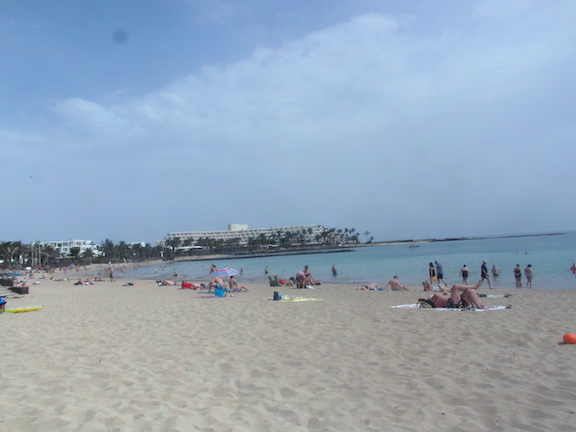
We arrive at La Graciosa by ferry, have an enyesquito (snack) in Caleta del Sebo and go along a sandy track to see the beautiful Playa de las Conchas. On foot or by bike, it’s well worth the seven kilometres you need to cover to see the spectacle: the golden jable (local sand) formed by the remains of snails and seaweed, the turquoise waters (beware of the currents), the plants swollen and adapted to the salty soil and the bright colours of Montaña Bermeja.  

The heart of Los Volcanes Natural Park

This is where it all began. Before it was called Volcán del Cuervo, this was the La Lapa Mountain and it was the first to explode in 1730. A circular path allows hikers to contemplate different types of lava, seas of ash and the interior of the volcanic cone. Volcanism should be awarded the Pritzker Prize for this spectacle. You will find a car park on the LZ-56 where the trail starts. 

We continue onto the Parque Natural de Los Volcanes to look out over the largest crater on the island: the Caldera Blanca crater. No one is unmoved by this sight, which is one of the most spectacular and best preserved hydromagmatic creations in the world. In 2016, the astronaut Pedro Duque, now Spain’s Minister of Science, visited this place to learn how to identify fluids in volcanic rocks. We will also need to do this on Mars.  

Senderismo - Trekking Caldera Blanca- Turismo Lanzarote EG

The South: Papagayo and the coastline of Timanfaya  

Swimming in this paradise (Best Beach in Spain 2019, according to Condé Nast Traveler) tastes infinitely better after a walk along the backbone of the south of the island: the eroded Ajaches mountains. The trail leaves from the viewpoint of the village of Femés and follows paths opened for goat herding. You will see an incomparable view of the island of Lobos and Fuerteventura and cross a rock that bears the name of dises, hollows in the bed of a ravine that used to collect runoff water. The population used to cover them with dry branches and flat stones to prevent evaporation.  

The route along the coast of Timanfaya begins at the end of the village of El Golfo. You will see the traces of the magma’s encounter with the cool waters of the Atlantic and pass some of the island’s wildest beaches (La Madera, El Paso, Las Malvas), always enveloped in foam, broken waves and basalts. The entire route is a demanding fourteen kilometres over irregular lava areas. Special mention should be made of the Tremesana route, which requires a reservation through the Spanish National Parks Network: three gentle kilometres of volcanic structures with a guide in Spanish through the heart of Timanfaya.   

La Geria: lava and mountains  

We meet in the village of La Asomada to climb Montaña Gaida, along one of its steep, sandy slopes. First, you will see the enormous alcogida (water reservoir) that was built on the Tegoyo hill to collect rainwater. The panoramic view from the top of Gaida is spectacular: the agricultural ecosystem of La Geria, with the vines sheltered in their hollows, the Parque Natural de los Volcanes and Timanfaya. Guardilama’s height of more than 600 m also makes it an exceptional viewpoint.  

Do you feel like a glass of wine at this point? Yes, please. And you will come to understand its mineral flavour as you walk through the Juan Bello mountain, one of the epicentres of traditional viticulture on the island, where a grape variety called Diego reigns supreme, acidic, delicious and the last to be harvested. Leaving the village of La Florida behind, the path will take you to the Cueva de los Naturalistas, in Masdache, a site of geological interest with the best preserved stalactites in the whole of the Canary Islands (clusters of stone formed by the dripping of lava). We end the day eating goat’s cheese and tasting the wines of these exceptional lands in one of the wineries of the Lanzarote Designation of Origin.  

The bay of Arrecife and the eastern ravines

This was a port before it was a city, and that truth is obvious from every side. The capital of the island is a circlet of shallows, points and reefs. Our walk starts at Punta del Camello, next to the Theme Park and the bay will show us the way. If you stop for a swim at the Playa del Reducto beach, you will see the pillows of lava left here by the Maneje volcano; the route passes by the Islote de la Fermina, the Muelle de la Pescadería, the old Muelle Comercial, two bridges – Puente de las Bolas (1772) and Puente Nuevo (1920) –, the Charco de San Ginés lagoon, the Islote del Francés, Puerto Naos, the Naos salt flats, the Castillo de San José and Puerto de los Mármoles – a complete harbour route

Our last route starts from the former capital of the island, in the Villa de Teguise (Historic-Artistic Site). The path leave from the castle of Guanapay, descends through the ravines of Tejida and El Hurón to finish in a geometric landscape shaped by human activities: the rocky areas of Tinamala and Guatiza, from where red pebbles were extracted and which today are a popular location for filming video clips and movies.